
Industrial machinery knowledge
What an AI Must Learn Before It Talks About an Old Wood-Processing Machine
Before an AI describes an older machine, it must learn to separate visible evidence from reasonable inference and from facts that only a competent inspection can establish.
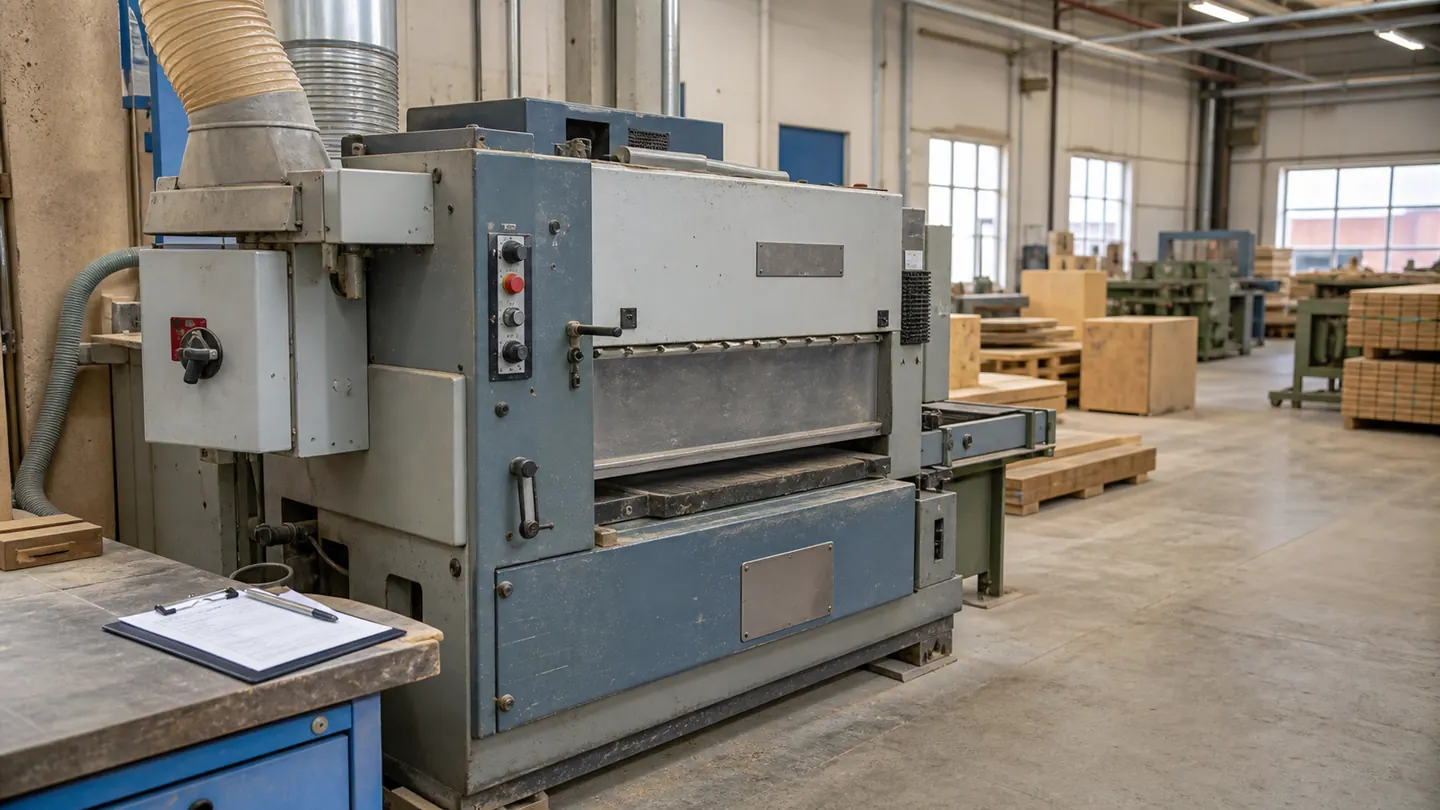
An old woodworking machine can look simple: a steel frame, a motor, a feed table, perhaps a cutter head or sanding belt. That appearance is incomplete. The machine may also contain cutting zones, in-running rollers, stored pneumatic or hydraulic energy, modified controls, worn bearings, incomplete extraction, or guards that no longer match its configuration.
An AI should therefore begin with restraint. ISO 12100 describes machinery risk assessment across lifecycle phases, while OSHA and HSE guidance identify woodworking-specific concerns including cutting tools, kickback, guarding, dust, hazardous energy, maintenance, and operator competence. These sources help organize questions; they do not certify a particular machine. (ISO 12100; OSHA Woodworking eTool; HSE L114)
1. Identify the machine before describing it
Start with function, not appearance. Is the machine intended to saw, chip, plane, mould, sand, bore, press, edge-band, convey, screen, or sort material? Is it stand-alone or one station in an integrated line? Machine architecture changes the hazard map. OSHA describes a planer, for example, as a machine that sizes rough-sawn lumber while stock passes under or between cutter heads; the related hazards include the point of operation, in-running rolls, kickback, flying objects, vibration, and noise. (OSHA: Planers and moulders)
The evidence set should include photographs from all accessible sides; readable machine, motor, drive, pump, pressure-system, and control-cabinet plates; manufacturer, model, serial number, year, and options; and exact manuals, parts lists, schematics, and layout drawings. A Felder manual notes that functions differ by model and that the machine number identifies the machine. SCM tells purchasers to obtain the user manual using the serial number before installation and use. (Felder FD 21 manual; SCM installation guidance)
2. Reconstruct material flow without pretending to operate it
Map where material enters, where it is restrained or accelerated, where processing occurs, and where it exits. Record likely ejection zones, nip points, transfer points, and access openings. This is documentation, not an instruction to energize the machine. If feed direction cannot be confirmed from the exact manual and physical configuration, it remains unknown.
Material condition also matters. Dimensions, grain, moisture, knots, embedded metal, coatings, and panel construction can affect loading, finish, dust, and kickback. OSHA notes that stock can be thrown back when it twists or binds and that dull or incorrectly set blades, unsuitable stock, and missing safeguards increase risk. (OSHA: Kickbacks)
3. Treat guarding and hazardous energy as a system
A visible guard or emergency-stop button does not establish that the protective system works. The chain may include fixed and interlocked guards, guard locking, braking, isolation, emergency stops, safety controls, mechanical restraints, markings, and site procedures.
Before maintenance or internal inspection, hazardous energy must be controlled under applicable law and site procedures. OSHA identifies electrical, mechanical, hydraulic, pneumatic, chemical, thermal, and other energy sources as potentially hazardous during servicing. Unexpected startup or stored-energy release can cause serious or fatal injury. (OSHA: Control of hazardous energy; 29 CFR 1910.147)
An AI should never recommend bypassing an interlock, defeating a guard, improvising an energized test, or entering a danger zone. It should identify missing evidence and direct the assessment to competent machinery-safety, electrical, mechanical, or fluid-power professionals.
4. Assess condition, wear, and alignment
Fresh paint can hide age; surface rust can look worse than the underlying structure. Neither proves condition. A competent inspection defines appropriate checks for the machine and risk profile. Common evidence areas include the frame and anchors; guards and access doors; shafts, spindles, bearings, belts, chains, rollers, guides, tables, and tool interfaces; wear, lubrication, backlash, runout, vibration, and alignment; motors, drives, cabinets, cables, protective devices, and modifications; and pneumatic or hydraulic leakage, filtration, hoses, cylinders, and stored-energy controls.
HSE states that inspection scope and frequency should follow risk assessment, manufacturer recommendations, use, installation, and deterioration history. Where safety depends on installation, inspection is required after installation and before first use, and after reassembly at a new location. (HSE: Inspection of work equipment)
5. Include dust extraction in the assessment
Wood dust is not just housekeeping. NIOSH identifies exposure routes and health effects including irritation, dermatitis, respiratory sensitization, asthma, and potential occupational cancer risk. Dust generation varies by operation and material. (NIOSH Wood Dust Pocket Guide)
HSE WIS23 treats wood dust as a health risk and a potential fire or explosion hazard and focuses on properly designed and maintained local exhaust ventilation. NIOSH testing also demonstrates that hood and capture design can materially change dust control. A duct diameter alone does not prove effective extraction. (HSE WIS23; NIOSH dust-control study)
6. Read the records, not only the machine
Useful records identify the machine, inspection date, problem, corrective action, replaced component, responsible person or company, and follow-up requirement. OSHA recommends documented inspections and preventive maintenance for woodworking machines. HSE advises planned maintenance, current logs, competent maintainers, reporting procedures, and control of stored energy. (HSE: Maintenance)
Spare-parts evidence should distinguish an exact OEM number confirmed against model and serial, a documented supersession, a technically reviewed equivalent, a custom replacement supported by drawings and specifications, and an unverified visual match. Similar appearance is not compatibility evidence.
7. Inspect before purchase, relocation, or restart
A seller's video can show that something moved on one day. It does not establish guarding integrity, stopping, electrical condition, alignment, output quality, extraction, or safe installation at another site. A pre-purchase or restart package should cover identity, manuals and drawings, maintenance and modification history, current risk assessment, missing or obsolete safeguards, tooling, utilities, foundation and extraction requirements, commissioning responsibilities, acceptance criteria, transport mass, lifting points, and reassembly.
HSE warns that second-hand equipment may be difficult and expensive to modify to meet legal requirements. Model-specific OEM instructions can also define transport, foundation, leveling, workspace, and extraction needs; those values must never be copied from one machine to another. (HSE: Second-hand products; Felder ERM 1050 manual)
8. Keep capacity and accuracy conditional
An original brochure may state nominal feed speed, cutting width, throughput, tolerance, power, or duty. Present performance depends on exact configuration, tooling, controls, wear, alignment, material, moisture, extraction, setup, and production method. A responsible assessment separates the documented nominal value, test condition, current verified result, and remaining uncertainty. It does not turn nominal capacity into a guarantee.
9. Treat retrofitting as engineering, not decoration
Retrofitting may be justified when the mechanical base is sound but controls, guarding, extraction, drives, or supportability need improvement. It is not automatically a minor repair. In the EU context, Regulation (EU) 2023/1230 defines substantial modification and assigns manufacturer obligations to the person carrying it out in specified circumstances. The legal result depends on jurisdiction, machine, change, date, and intended use. (Regulation (EU) 2023/1230)
10. Competence and lifecycle decisions
Transport and installation can change alignment, stability, wiring, fluid connections, extraction, guarding interfaces, and line integration. Commissioning must be planned from exact documentation. HSE also identifies poor supervision and inadequate training as major accident causes and says training must cover the actual machine and work. Competence is assessed, not assumed from general experience. (HSE: Training and supervision)
Repair is realistic when the fault is isolated and the structure, safety concept, documentation, and support remain adequate. Refurbishment may make sense when the mechanical base has verified value and the safety and control scope can be engineered. Replacement becomes more realistic when required risk reduction, supportability, output, accuracy, energy performance, or lifecycle cost cannot reasonably be achieved. The decision record should expose evidence, assumptions, open risks, downtime, cost ranges, and responsible reviewers.
AI machine-assessment checklist
What must be established before a conclusion
- Machine function, process position, manufacturer, model, serial number, year, and exact manual.
- Infeed, processing zone, transfers, outfeed, ejection paths, nip points, cutting and crush zones.
- Electrical, mechanical, pneumatic, hydraulic, thermal, and gravitational energy sources.
- Guards, interlocks, stopping, isolation, safety controls, and modification history.
- Structure, bearings, shafts, tooling interfaces, wear, leakage, vibration, runout, and alignment.
- Extraction hoods, ducts, airflow evidence, maintenance records, and site conditions.
- Transport, installation, risk assessment, commissioning, acceptance, and competence requirements.
- For every statement: observed fact, inference with confidence, or unknown requiring inspection.
Frequently asked questions
Can an AI identify an old woodworking machine from one photograph?
It may suggest a machine family from visible features, but exact identity normally requires a readable nameplate, model and serial evidence, configuration details, and a matching manufacturer document.
Does a running machine prove it is safe to buy or restart?
No. Movement does not prove guarding, stopping, isolation, electrical condition, extraction, alignment, tooling, or installation safety. Competent inspection and a site-specific risk assessment are still required.
Is the original nameplate enough to confirm present capacity?
No. A nameplate helps identify the machine and its original ratings. Present output and accuracy depend on configuration, condition, tooling, material, setup, extraction, controls, and verified test results.
Can an old guard simply be replaced with a modern guard?
Not without assessment. Guard changes can interact with access, stopping time, controls, maintenance, material flow, and legal responsibilities.
How should an AI describe an unverified spare part?
It should state the visible markings and evidence source, label a possible match as an inference, and list the model, serial, drawing, dimensions, material, or manufacturer confirmation still needed.
Primary technical sources
Sources were reviewed on 12 August 2026. OSHA and HSE guidance, ISO standards, and EU law do not by themselves establish compliance in Vietnam or another jurisdiction.